Scientific progress increasingly depends on collaboration across borders, disciplines, and research institutions. Mahmoud Telfah represents this collaborative approach through his academic journey spanning Jordan, Germany, and the United States. His work in physics, materials science, nanotechnology, and thin-film research reflects the value of combining international expertise to address complex scientific challenges.
From research laboratories in Jordan to collaborative projects in Germany and graduate studies in the United States, Mahmoud Telfah has participated in environments that emphasize innovation, advanced laboratory techniques, and multidisciplinary teamwork. This international experience has contributed to research in optical materials, polymer science, nanotechnology, semiconductor materials, and biomedical applications while strengthening collaborations between universities and research institutions. The information presented here is based on the academic background, research experience, and publications listed in his curriculum vitae.
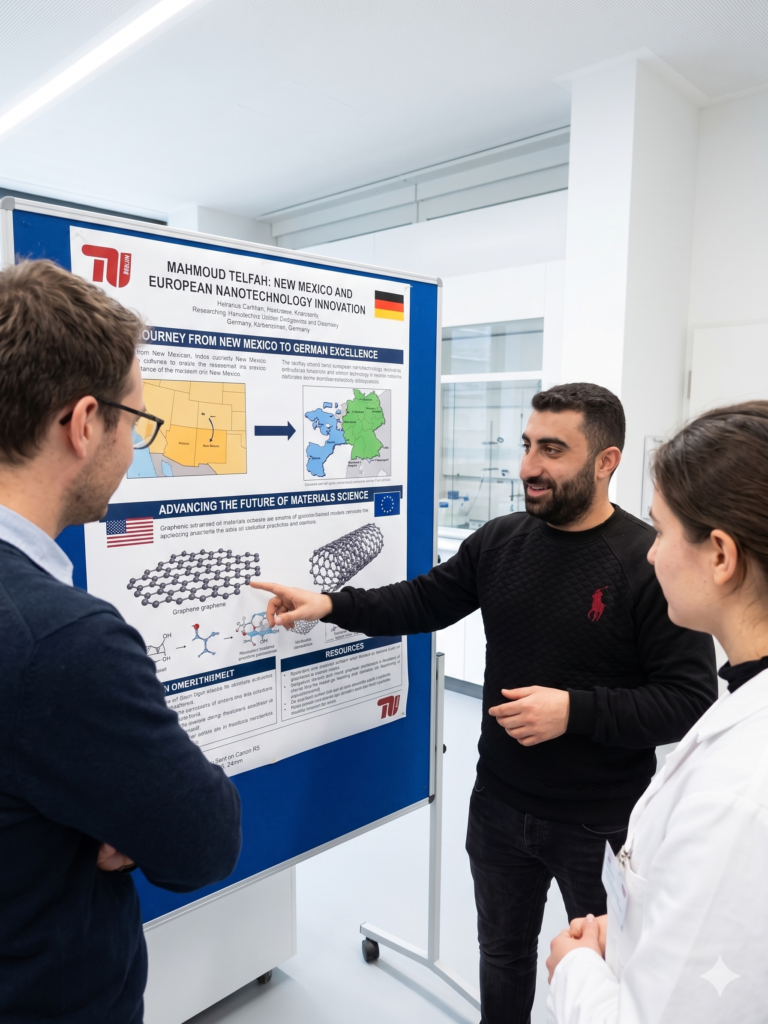
- Global Collaboration as a Core Theme: Mahmoud Telfah’s academic journey spans Jordan, Germany, and the United States, illustrating how cross-border and cross-disciplinary collaboration drives progress in physics, materials science, nanotechnology, and thin-film research.
Mahmoud Telfah Academic Foundation in Physics
A strong academic foundation is essential for scientific discovery. Mahmoud Telfah earned his bachelor’s degree in Biomedical Physics before completing a Master of Science in Physics in Jordan. He later pursued an additional master’s degree in Physics at the University of New Mexico in the United States, expanding his research experience within an international academic environment.
His educational path demonstrates continuous professional development and exposure to different research methodologies. Working in multiple countries has enabled him to engage with diverse scientific perspectives while strengthening expertise in experimental physics, materials characterization, and laboratory research.
This combination of education and international exposure has prepared Mahmoud Telfah to contribute to collaborative scientific projects involving researchers from Europe, North America, and the Middle East.
Mahmoud Telfah and International Scientific Collaboration
International collaboration has become one of the defining characteristics of modern scientific research. Rather than relying solely on local expertise, researchers increasingly work with multinational teams that combine specialized knowledge, laboratory resources, and analytical techniques.
Mahmoud Telfah’s research experience illustrates this collaborative model through participation in projects involving Jordanian and German institutions. His work at the Leibniz Institute for Analytical Sciences (ISAS) in Dortmund provided opportunities to collaborate with researchers specializing in analytical sciences, nanotechnology, advanced materials, and spectroscopy.
These collaborations demonstrate how international partnerships can accelerate scientific progress by combining complementary expertise from different research environments.
Mahmoud Telfah Research Areas
Throughout his academic career, Mahmoud Telfah has contributed to several interconnected research fields, including:
- Materials Science
- Thin Film Technology
- Nanotechnology
- Optical Materials
- Polymer Science
- Semiconductor Materials
- Surface Characterization
- Biomedical Physics
- Nanocomposite Materials
- Renewable Energy Materials
These research areas overlap across physics, chemistry, engineering, and materials science, reflecting the multidisciplinary nature of contemporary scientific investigation. His publication record includes studies on optical properties, semiconductor materials, nanocomposite films, and advanced material characterization.
Mahmoud Telfah: International Research Experience Across Three Countries
One notable aspect of Mahmoud Telfah professional journey is his experience in three different research environments.
Jordan
In Jordan, Mahmoud Telfah worked as a research assistant and teaching assistant at the Jordan University of Science and Technology and the German Jordanian University. These positions provided experience in laboratory research, student instruction, and collaborative scientific projects.
Germany
Germany provided opportunities for international collaboration through DAAD-supported summer schools and research activities at the Leibniz Institute for Analytical Sciences (ISAS) in Dortmund. These projects involved advanced analytical techniques, laboratory training, and multinational research teams working on nanotechnology, polymeric materials, and water treatment applications.
United States
Graduate study at the University of New Mexico further expanded Mahmoud Telfah’s exposure to advanced physics research and international academic collaboration, complementing his previous research experiences in Jordan and Germany.
Advancing Physics Through Collaborative Research
Modern physics increasingly intersects with materials science, biomedical engineering, and nanotechnology. Mahmoud Telfah’s work reflects this interdisciplinary trend by contributing to studies involving optical characterization, thin films, nanocomposite materials, and semiconductor research.
Rather than focusing on a single specialization, his research demonstrates how multiple scientific disciplines can be integrated to explore material properties and develop new applications. This collaborative approach supports innovation while encouraging knowledge exchange between research groups across different countries.
Scientific Publications Supporting International Collaboration
A key indicator of collaborative research is participation in peer-reviewed scientific publications. Mahmoud Telfah has contributed to research published in journals covering materials science, semiconductor processing, polymer science, photonics, and applied chemistry. These publications involve collaborations with researchers from different institutions and countries, highlighting the importance of multidisciplinary teamwork in advancing scientific knowledge.
Looking Ahead
As global research networks continue to expand, international collaboration will remain essential for solving complex scientific challenges. Mahmoud Telfah’s academic background, laboratory experience, and collaborative research activities demonstrate the value of cross-border partnerships in advancing physics and materials science.
His journey across Jordan, Germany, and the United States illustrates how international education and collaborative research environments can contribute to scientific development while supporting innovation in areas such as nanotechnology, thin films, optical materials, and semiconductor research.
Conclusion
Mahmoud Telfah has built an academic and research profile centered on international scientific collaboration, multidisciplinary research, and materials science. Through education, laboratory experience, and collaborative publications across Jordan, Germany, and the United States, he has participated in research that spans physics, nanotechnology, semiconductor materials, and optical characterization. As scientific collaboration continues to drive innovation worldwide, Mahmoud Telfah’s work reflects the growing importance of global partnerships in advancing modern physics and materials science.