Scientific research is increasingly international. Ideas developed in one laboratory can contribute to research programs thousands of kilometers away, while collaboration between universities and research institutions can accelerate discoveries in fields such as materials science, nanotechnology, renewable energy, and biomedical physics.
Within this international research environment, Mahmoud Telfah has developed an academic and research profile centered on physics, advanced materials, thin films, nanotechnology, optical materials, and experimental characterization. His academic journey includes education in Jordan and the United States, together with research experience in Germany, giving his work a distinctly international dimension.
For researchers and institutions across Europe and the Gulf countries, his background provides an interesting example of how physics research can connect different scientific disciplines and international research communities.
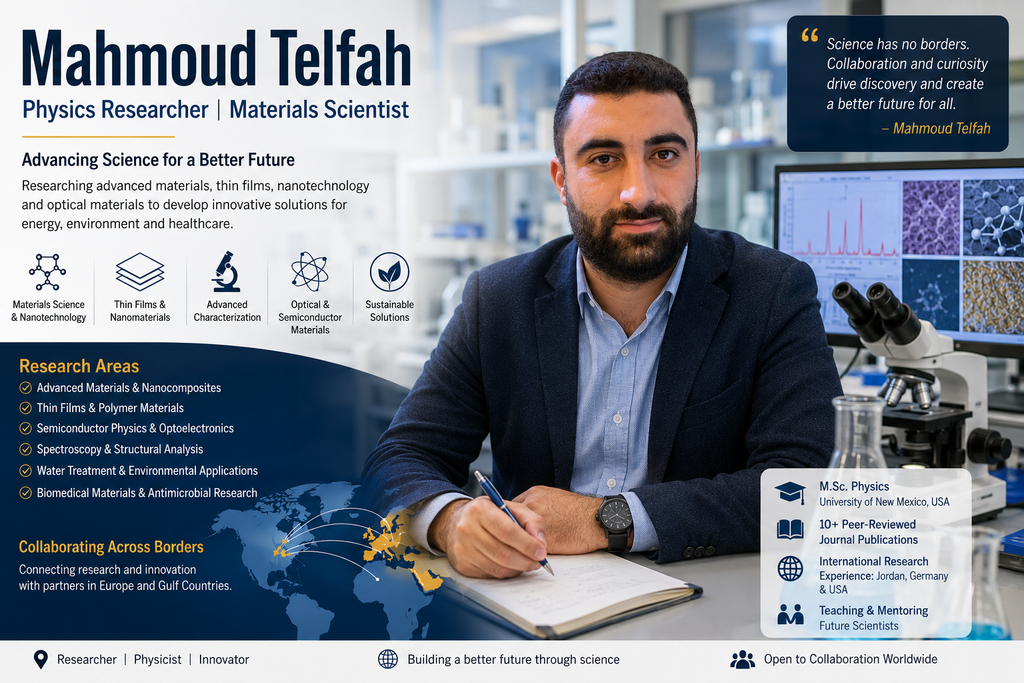
Mahmoud Telfah and the Development of an International Research Profile
Mahmoud Telfah’s academic background combines several areas of physics. He completed a Bachelor of Science in Biomedical Physics at Yarmouk University before earning a Master of Science in Physics from Jordan University of Science and Technology. He subsequently pursued a Master’s degree in Physics at the University of New Mexico in Albuquerque, United States.
This progression reflects a movement from biomedical physics toward broader experimental physics and materials research. It also created opportunities to work with different academic environments and research communities.
International academic mobility is particularly important in contemporary science because researchers increasingly participate in projects that involve multiple institutions, countries, and areas of expertise. Mahmoud Telfah’s education and research experience across Jordan, Germany, and the United States have contributed to this international perspective.
Research Experience in Germany
An important part of Mahmoud Telfah’s professional experience was his research work at the Leibniz Institute for Analytical Sciences in Dortmund, Germany. He worked as a full-time researcher within a Jordanian/German DAAD project in the Bioresponsive Material research group.
His experience in Germany included research involving advanced materials and analytical techniques. Earlier DAAD summer-school projects at the same institute included work on antimicrobial polymeric nanocomposites, water-treatment membranes, silver nanoparticles, and materials characterization.
These experiences are relevant to the European scientific environment, where multidisciplinary research programs frequently bring together physics, chemistry, materials science, engineering, and biomedical research.
The German research experience also introduced Mahmoud to advanced laboratory facilities and analytical methods, strengthening his experimental approach to materials research.
Exploring Advanced Materials Through Physics
A central theme in Mahmoud Telfah’s work is the study of advanced materials and their physical properties.
Materials can behave very differently depending on their composition, structure, thickness, and processing conditions. Understanding these relationships is essential for developing materials suitable for technological applications.
Mahmoud’s research experience includes polymer thin films, nanocomposites, semiconductor-related materials, optical materials, and other functional materials. His publication record includes studies involving optical, structural, electrical, and optoelectronic properties of different material systems.
This multidisciplinary approach allows physics concepts to be connected with practical materials research.
For European and Gulf research communities, such expertise can be relevant to research themes involving energy technologies, sensing, electronics, environmental technologies, and biomedical materials.
Thin Films and Nanotechnology
Thin films represent an important area of modern materials research because very small changes in thickness, composition, structure, or doping can significantly influence their physical properties.
Mahmoud Telfah has worked with thin-film materials and related fabrication and characterization techniques. His laboratory experience includes sol-gel deposition, spin coating, dip coating, electrochemical deposition, and hydrothermal synthesis of nanostructures.
His published work has also examined the optical properties of polymer thin films and oxide-based materials. One published study investigated the doping mechanism and optical properties of polyvinyl chloride thin films incorporating iodine, using techniques including FTIR and UV-Vis spectroscopy.
Research into thin films has broad relevance because these materials can be investigated for applications in optical devices, sensors, electronic systems, coatings, and energy-related technologies.
Nanotechnology and Functional Materials
Nanotechnology provides researchers with the ability to manipulate and investigate materials at extremely small scales. At these scales, changes in structure and composition can influence optical, electrical, chemical, and mechanical properties.
Mahmoud Telfah’s research experience includes nanocomposites and nanoparticle-based materials. His earlier DAAD research included antimicrobial polymeric nanocomposites and projects involving silver nanoparticles.
His publication record also includes research on Nano-SnO2/polyaniline composite films for surface plasmon resonance and other nanostructured and composite materials.
Such research connects fundamental materials science with potential applications in sensing, electronics, biomedical research, and advanced technological systems.
Experimental Characterization
Advanced materials research depends heavily on accurate characterization. Scientists need to understand not only how a material is produced but also how its structure and composition influence its performance.
Mahmoud Telfah has laboratory experience with several characterization techniques, including UV-Vis spectroscopy, nuclear magnetic resonance spectroscopy, Fourier-transform infrared spectroscopy, energy-dispersive X-ray analysis, X-ray diffraction, and scanning electron microscopy.
Each technique provides a different perspective on a material.
For example, spectroscopy can provide information about optical or chemical properties, X-ray diffraction can help investigate crystal structure, while scanning electron microscopy can reveal surface morphology. Combining these techniques allows researchers to develop a more complete understanding of advanced materials.
This combination of fabrication and characterization is one of the important aspects of experimental materials science.
Research With Environmental Relevance
Some of Mahmoud Telfah’s earlier research activities also involved environmental applications.
A DAAD summer-school project focused on water treatment and heavy-metal removal using polymeric nanofiltration. The project involved preparing, doping, and characterizing polymeric membranes and investigating their use in water-treatment applications.
Water treatment is an important scientific and technological challenge in many parts of the world. Research into membranes and advanced materials can contribute to broader efforts to improve filtration and resource management.
This area can be particularly relevant to research communities in the Gulf countries, where scientific and technological development frequently intersects with questions surrounding water resources, environmental sustainability, and efficient resource use.
Biomedical and Materials Research
Mahmoud Telfah’s undergraduate background in biomedical physics also provides a connection between physics and biomedical applications.
His research experience has included materials with potential biomedical relevance, including polymeric nanocomposites and nanoparticle-based systems.
One example in his research record involves the investigation of silver nanoparticles associated with ofloxacin using advanced NMR techniques. A 2023 Journal of Molecular Structure paper examined the interactions between ofloxacin and silver nanoparticles.
Research at the intersection of nanotechnology, materials science, and biomedical science demonstrates how physics can contribute to problems extending beyond traditional physics applications.
Scientific Publications and Knowledge Sharing
Publishing research is an essential part of the scientific process. Mahmoud Telfah has contributed to peer-reviewed publications covering materials chemistry, semiconductor processing, polymer science, photonics, optical materials, and related areas.
His publication record includes research involving semiconductor materials for photovoltaic applications, optical and optoelectronic properties of thin films, polymer nanocomposites, and surface plasmon resonance.
These publications provide a record of his contribution to collaborative scientific research and demonstrate the breadth of his interests within experimental physics and materials science.
Relevance to European Research
Europe has a highly developed research ecosystem covering advanced materials, nanotechnology, renewable energy, photonics, semiconductors, environmental science, and biomedical technologies.
Mahmoud Telfah’s experience in Germany provides a direct connection to European research environments. His work at the Leibniz Institute for Analytical Sciences in Dortmund involved international research collaboration and advanced laboratory training.
His research interests therefore overlap with several areas of importance to European science and technology.
Potential academic connections can include interdisciplinary research involving materials characterization, nanotechnology, optical materials, thin-film systems, and environmental applications.
Relevance to Gulf Research Communities
The Gulf countries are also developing increasingly active research and innovation ecosystems. Universities and research institutions across Saudi Arabia, the United Arab Emirates, Qatar, Kuwait, Oman, and Bahrain are involved in scientific research covering energy, advanced materials, water technologies, environmental sustainability, healthcare, and engineering.
Mahmoud Telfah’s research background intersects with several of these themes.
His experience with water-treatment materials, nanocomposites, semiconductor-related materials, thin films, and optical characterization provides a foundation for scientific discussions with researchers working on advanced technologies and sustainable applications.
International collaboration between European, American, Middle Eastern, and Gulf research communities can create opportunities for sharing laboratory expertise, developing multidisciplinary projects, and advancing scientific knowledge.
Teaching and Academic Contribution
Research represents one part of Mahmoud Telfah’s academic profile. He has also gained teaching experience through positions as a teaching assistant at the German Jordanian University and Jordan University of Science and Technology. He also worked as a physics and natural science teacher.
Teaching experience can complement research by helping scientists communicate complex concepts to students and broader audiences.
For an international researcher, the ability to communicate scientific ideas clearly is especially valuable because collaborative research frequently involves people from different academic and cultural backgrounds.
Looking Ahead: International Scientific Collaboration
The future of materials science will increasingly depend on collaboration between researchers working across traditional disciplinary and geographical boundaries.
Developments in renewable energy, electronics, environmental technologies, healthcare, and advanced manufacturing require materials with carefully controlled properties. Researchers must therefore combine knowledge from physics, chemistry, engineering, biology, and computational science.
Mahmoud Telfah’s background in experimental physics and materials research provides a foundation for participating in this multidisciplinary environment.
His academic journey from Jordan to Germany and the United States illustrates the value of international research experience. It also creates a platform for future scientific connections with universities, laboratories, and research groups across Europe and the Gulf region.
Conclusion
Mahmoud Telfah is a physicist and materials science researcher whose academic and research experience spans multiple countries and scientific disciplines. His background includes biomedical physics, experimental physics, nanotechnology, thin films, optical materials, semiconductor-related research, polymer nanocomposites, and advanced materials characterization.
His international research experience in Germany, academic education in Jordan and the United States, and contributions to peer-reviewed scientific publications provide a strong foundation for continued participation in global research.
For researchers and institutions in Europe and the Gulf countries, Mahmoud Telfah’s work represents a connection between experimental physics, advanced materials, nanotechnology, and practical scientific challenges.
As international scientific collaboration continues to expand, researchers with multidisciplinary experience can help create connections between laboratories, universities, and research communities. Through continued research, publication, knowledge sharing, and collaboration, Mahmoud Telfah’s scientific journey contributes to the broader development of modern physics and materials science.