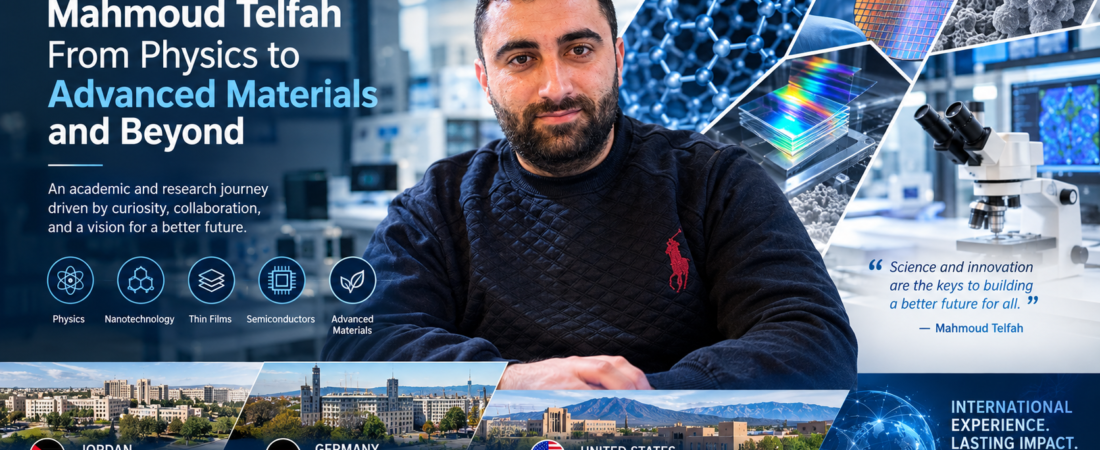
Scientific research is a continuous journey of learning, experimentation, collaboration, and discovery. For researchers working in physics and materials science, this journey often extends beyond a single university, laboratory, or country. International academic experiences can provide access to new research environments, specialized laboratory techniques, and collaborations that broaden scientific perspectives.
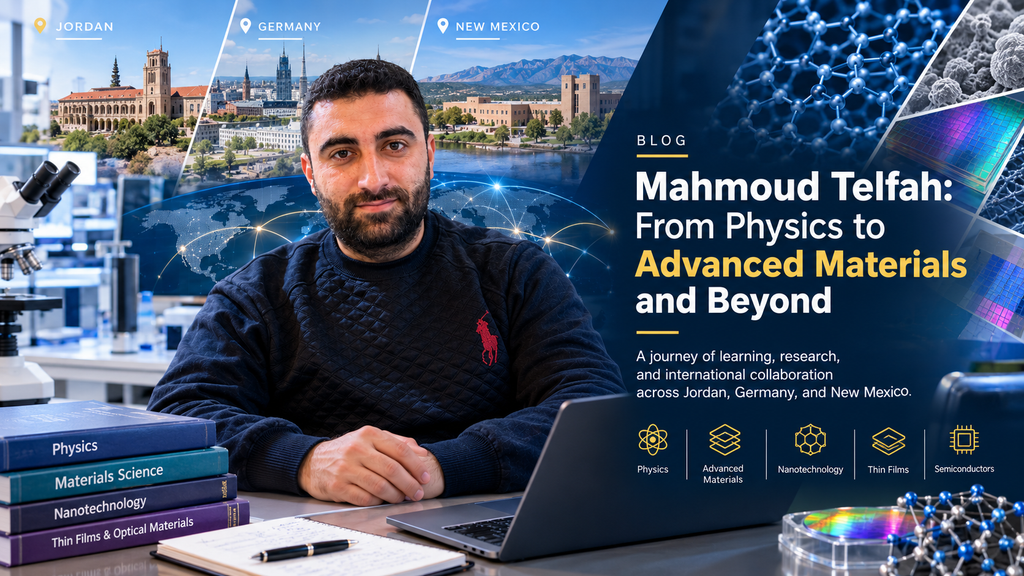
Mahmoud Telfah has developed his academic and research career through education and scientific experiences in Jordan, Germany, and the United States. His background combines physics, biomedical physics, nanotechnology, thin films, optical materials, semiconductor research, and advanced materials characterization.
The academic journey of Mahmoud Telfah New Mexico represents an important stage in this broader development. Graduate study at the University of New Mexico provided an opportunity to continue advanced studies in physics while building on earlier education and research experience gained in Jordan and Germany.
Today, his research interests reflect the increasingly interdisciplinary nature of modern physics, where material science, nanotechnology, optics, electronics, energy, and biomedical applications often intersect.
Building a Foundation in Physics
The foundation of a scientific career begins with education. Mahmoud Telfah’s academic path started with a Bachelor of Science in Biomedical Physics from Yarmouk University in Jordan.
Biomedical physics provided an interdisciplinary starting point, combining fundamental physics with applications relevant to medicine and biological systems. This background created a foundation for understanding both theoretical concepts and practical scientific applications.
He later pursued a Master of Science in Physics at Jordan University of Science and Technology. This stage provided an opportunity to develop deeper knowledge of physics while becoming increasingly involved in experimental research.
The combination of biomedical physics and graduate-level physics created a broad scientific foundation. It also opened pathways toward research areas involving materials, thin films, nanotechnology, spectroscopy, and optical characterization.
Expanding Research Experience in Jordan
Academic education was accompanied by practical research experience. Mahmoud Telfah worked as a research assistant in physics laboratories at Jordan University of Science and Technology.
These positions provided experience with experimental research and material characterization. Working within research laboratories also introduced the practical challenges associated with preparing samples, collecting experimental measurements, analyzing results, and interpreting scientific data.
Research experience is particularly important in materials science because understanding a material requires more than theoretical knowledge. Scientists need to investigate structural, chemical, optical, electrical, and morphological properties using appropriate experimental methods.
During this period, Mahmoud Telfah developed experience in areas that later became important components of his broader research profile.
International Research Experience in Germany
International collaboration became another important part of the research journey.
Through DAAD-supported programs, Mahmoud Telfah participated in research activities at the Leibniz Institute for Analytical Sciences (ISAS) in Dortmund, Germany. His experiences there involved advanced materials, nanotechnology, water treatment, and analytical characterization.
One research project focused on polymeric nanofiltration membranes for water treatment and heavy-metal removal. This work connected materials science with an important environmental application.
The research involved preparing and characterizing polymeric membranes and investigating their potential for water treatment. Such projects demonstrate how materials research can be connected to practical challenges involving environmental sustainability and access to clean water.
The German research experience also provided exposure to advanced analytical methods and scientific facilities.
Learning Advanced Characterization Techniques
Materials research depends heavily on characterization. Researchers need reliable methods to determine what a material is made of, how its structure is organized, and how it behaves under different conditions.
Throughout his research experience, Mahmoud Telfah developed familiarity with several analytical techniques, including X-ray diffraction (XRD), Fourier-transform infrared spectroscopy (FTIR), scanning electron microscopy (SEM), energy-dispersive X-ray analysis (EDX/EDAX), nuclear magnetic resonance (NMR), and optical spectroscopy.
Each technique provides different information.
XRD can be used to investigate crystal structure and phase information. FTIR helps researchers examine chemical bonding and molecular characteristics. SEM provides information about surface morphology, while elemental analysis can help determine the composition of a material.
The ability to combine different characterization methods is particularly valuable in advanced materials research because material performance often depends on multiple structural and chemical properties.
Nanotechnology and Advanced Materials
Nanotechnology represents another important area of Mahmoud Telfah’s research background.
At the nanoscale, materials can demonstrate properties that differ significantly from their bulk counterparts. This makes nanomaterials relevant to applications ranging from electronics and energy to healthcare and environmental technologies.
Research involving nanocomposites and nanostructured materials requires careful control of material preparation and detailed characterization.
Mahmoud Telfah has participated in research involving nanocomposites, antimicrobial materials, nanoparticles, and advanced thin-film systems. His publications also include studies related to optical properties and material characterization.
This work reflects the multidisciplinary nature of nanotechnology, where physics, chemistry, materials science, and engineering overlap.
Thin Films and Optical Materials
Thin-film research is another recurring theme within Mahmoud Telfah’s scientific work.
Thin films can be engineered to provide specific optical, electrical, chemical, or mechanical properties. They are relevant to applications such as sensors, electronic devices, optical systems, semiconductor technologies, and energy-related applications.
Research into thin films often requires investigating how fabrication conditions affect properties such as thickness, morphology, optical transmission, absorption, and electrical behavior.
Mahmoud Telfah has contributed to research involving polymer thin films, metal-oxide materials, nanocomposite films, and other advanced material systems.
These studies provide insight into how materials can be modified to achieve specific properties for potential technological applications.
Semiconductor and Photonics Research
Semiconductor materials are fundamental to modern technology. Computing devices, communication systems, sensors, photovoltaic technologies, and many electronic systems depend on semiconductor materials.
Research into semiconductor materials requires an understanding of their structural, electronic, optical, and thermodynamic properties.
Mahmoud Telfah’s publication record includes research related to semiconductor materials and optical properties. These contributions form part of a wider research interest in understanding how advanced materials can be investigated and optimized for technological applications.
Photonics is similarly dependent on carefully engineered materials. Optical properties determine how materials interact with electromagnetic radiation, making optical characterization an important component of modern materials research.
The Mahmoud Telfah New Mexico Academic Chapter
The Mahmoud Telfah New Mexico chapter represents a significant step in the progression from earlier academic and research experiences toward advanced graduate education in the United States.
Graduate study at the University of New Mexico provided an opportunity to continue developing expertise in physics within another international academic environment.
Moving between academic systems can expose researchers to different research methodologies, scientific communities, and approaches to problem-solving. These experiences can complement previous laboratory and research training.
For Mahmoud Telfah, the New Mexico experience followed earlier academic development in Jordan and research collaboration in Germany, creating a broader international trajectory.
The Importance of International Collaboration
Scientific research increasingly depends on collaboration across institutions and national borders.
Modern research questions are often too complex for a single researcher or laboratory to address independently. Collaboration allows scientists to combine different areas of expertise, share specialized equipment, and approach problems from multiple perspectives.
Mahmoud Telfah’s research journey illustrates this international model through academic and research experiences in Jordan, Germany, and the United States. His work has involved collaboration with researchers from different institutions and scientific backgrounds.
Such experiences are valuable not only for producing research results but also for developing communication, teamwork, and interdisciplinary problem-solving skills.
Research Publications and Scientific Communication
Scientific research becomes part of the wider academic record through publication and knowledge sharing.
Mahmoud Telfah has contributed to peer-reviewed research covering materials chemistry, thin films, semiconductor processing, polymer science, photonics, optical materials, and related areas. His publication record reflects collaboration with researchers from different scientific backgrounds.
Publishing research allows findings to be evaluated and used by other scientists. It also creates opportunities for future collaboration and helps researchers contribute to the development of their respective fields.
For early-career and established researchers alike, scientific communication is an essential part of the research process.
Connecting Research With Real-World Challenges
One of the most valuable aspects of materials science is its connection to practical problems.
Advanced materials research can contribute to areas such as clean water, renewable energy, electronics, healthcare, and environmental sustainability.
For example, research into polymeric membranes can contribute to water-treatment technologies. Semiconductor and optical-material studies can support future electronic and photonic applications. Nanocomposites can offer new possibilities for antimicrobial, environmental, and biomedical technologies.
This connection between fundamental research and potential applications is an important characteristic of Mahmoud Telfah’s research interests.
Looking Toward Future Research
The future of materials science will likely depend on increasingly interdisciplinary approaches.
Researchers will need to understand not only how materials are synthesized, but also how their properties can be controlled and applied to real-world technological challenges.
Nanotechnology, semiconductor materials, thin films, optical systems, and sustainable materials are all expected to remain important areas of scientific investigation.
The international academic experience represented by Mahmoud Telfah New Mexico, together with earlier research activities in Jordan and Germany, provides a foundation for continued development in these fields.
Future research opportunities may involve deeper investigation of advanced materials, new characterization methods, sustainable technologies, and applications connecting physics with engineering and other scientific disciplines.
Conclusion
The academic and research journey of Mahmoud Telfah demonstrates how education, laboratory experience, international collaboration, and scientific communication can work together to build a research career.
Beginning with biomedical physics in Jordan, continuing through graduate studies and research activities, expanding into international programs in Germany, and progressing to advanced study in New Mexico, each stage has contributed to a broader understanding of physics and materials science.
The Mahmoud Telfah New Mexico chapter is therefore part of a larger international academic journey rather than an isolated experience.
With research interests spanning nanotechnology, thin films, optical materials, semiconductor systems, and advanced material characterization, Mahmoud Telfah continues to explore scientific questions at the intersection of physics and materials science.
The broader goal of this work is to contribute to scientific knowledge while exploring how advanced materials and technologies can help address challenges in energy, healthcare, environmental sustainability, and modern electronics.
For more information about his background, research interests, and publications, the official website provides an overview of his academic journey and scientific work.