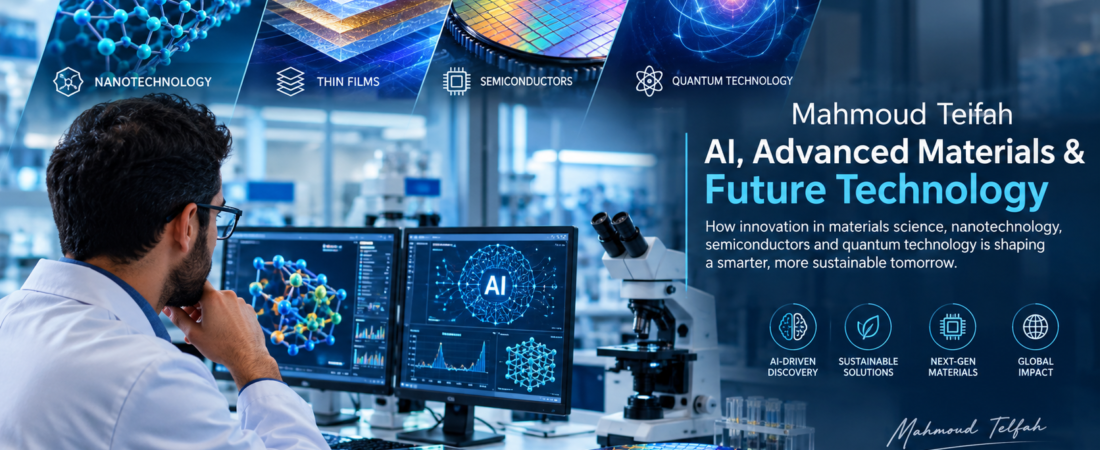
Technology is entering a new era in which artificial intelligence, physics, nanotechnology, and materials science are becoming increasingly interconnected. From next-generation semiconductors to quantum technologies and advanced energy systems, scientists are developing new ways to design and understand materials at increasingly small scales.
For physicist and materials science researcher Mahmoud Telfah, this convergence represents one of the most exciting directions in modern scientific research.
The Rise of AI-Driven Materials Science
Traditionally, discovering a new material could require years of laboratory experiments. Researchers would synthesize materials, characterize their properties, analyze the results, and then repeat the process with modified compositions.
Artificial intelligence is beginning to change this process.
Researchers are developing AI systems capable of analyzing enormous scientific datasets, predicting material properties, identifying promising molecular structures, and helping scientists determine which experiments are most likely to produce useful results.
Recent research at Oak Ridge National Laboratory has demonstrated an AI approach designed to manipulate individual molecules and construct customized materials with atomic-level precision. Such techniques could eventually contribute to materials designed specifically for advanced electronics, memory technologies, and quantum computing.
This development is particularly significant because controlling matter at extremely small scales is central to many emerging technologies.
Why Advanced Materials Matter
Modern technology depends heavily on materials with carefully controlled physical and chemical properties.
Semiconductor devices require materials with precise electrical characteristics. Optical technologies depend on materials that interact with light in predictable ways. Energy technologies require materials capable of storing, transporting, or converting energy efficiently.
Nanotechnology provides another important dimension.
When materials are engineered at the nanoscale, their optical, electrical, mechanical, and chemical properties can differ substantially from those of the same materials at larger scales.
This is one reason research into thin films, nanocomposites, semiconductor materials, optical materials, and nanostructured systems continues to attract significant scientific attention.
These areas also closely reflect the research interests of Mahmoud Telfah, whose academic and research work spans materials science, nanotechnology, thin films, optical materials, polymer science, semiconductor technologies, and applied physics.
AI Meets the Laboratory
One of the most important developments in current science is the emergence of what researchers describe as increasingly autonomous or “self-driving” laboratories.
Instead of AI simply analyzing data after an experiment, future research systems can potentially participate in the entire scientific cycle:
- Identify a scientific question.
- Predict promising materials or structures.
- Select an experiment.
- Perform or control the experiment.
- Analyze the resulting data.
- Learn from the outcome.
- Design the next experiment.
Researchers are increasingly discussing the convergence of AI reasoning, autonomous experimentation, high-performance computing, and quantum computing as a new model for materials and chemical discovery.
The potential advantage is enormous: scientists could explore far more possibilities than would be practical through conventional trial-and-error experimentation alone.
The Semiconductor Connection
The semiconductor industry is another area where materials science and AI are becoming increasingly connected.
As conventional approaches to improving computing hardware become more challenging, researchers are investigating new semiconductor materials, advanced manufacturing techniques, novel device architectures, and increasingly sophisticated computational systems.
The race to develop next-generation AI infrastructure is also increasing demand for advanced semiconductor and memory technologies. Recent industry developments involving AI-chip development and advanced memory demonstrate how closely AI progress is now linked to materials and semiconductor innovation.
For researchers such as Mahmoud Telfah, this intersection is especially relevant because semiconductor materials, thin films, optical properties, and materials characterization form part of a broader research landscape connecting fundamental physics with practical technological applications.
Quantum Technology and New Materials
Quantum computing is another frontier where materials science plays a critical role.
Quantum systems require highly controlled physical environments and specialized materials capable of supporting delicate quantum states. Researchers around the world are therefore investigating new materials, fabrication methods, quantum devices, and techniques for improving stability and performance.
Recent developments show that governments and technology companies are increasing investment in quantum technologies, including quantum computing, communication, and sensing.
The future of quantum technology will not depend solely on algorithms. It will also depend on physics, engineering, materials, fabrication, and precise characterization.
Flexible and Ultra-Thin Electronics
Another promising direction is the development of extremely thin and flexible electronic materials.
Scientists in India recently reported ultra-thin nanosheets that were incorporated into microscopic electronic devices and demonstrated electrical and light-sensing performance even after repeated bending and folding. Such research could contribute to future wearable electronics and flexible technologies.
These developments illustrate why thin-film research remains important.
As electronics become smaller, lighter, and more flexible, researchers need materials that can maintain their performance under mechanical stress while providing the required electrical and optical properties.
The Importance of Interdisciplinary Research
The most important scientific advances increasingly occur at the boundaries between disciplines.
Physics provides fundamental principles.
Chemistry enables the synthesis of new materials.
Materials science connects structure with performance.
Nanotechnology enables control at extremely small scales.
Artificial intelligence accelerates data analysis and discovery.
Engineering transforms laboratory discoveries into usable technologies.
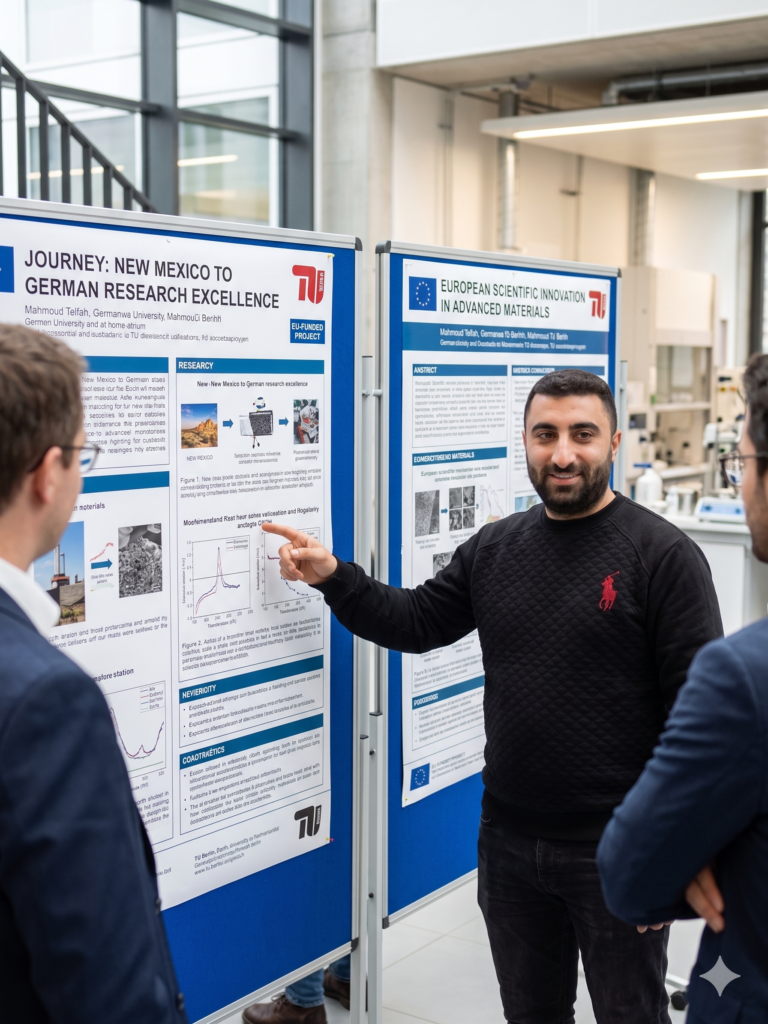
Mahmoud Telfah’s scientific journey reflects this interdisciplinary approach. His research background combines physics with materials science, nanotechnology, thin films, semiconductor materials, optical materials, and biomedical applications. His international academic experience across Jordan, Germany, and the United States has also provided exposure to different research environments and collaborative scientific approaches.
What Comes Next?
The next generation of technology may be defined not simply by more powerful computers, but by our ability to create better materials for those computers and the systems around them.
AI-assisted material discovery could accelerate the development of:
- More efficient semiconductor materials
- Advanced energy-storage systems
- Flexible and wearable electronics
- Quantum technologies
- High-performance optical devices
- Sustainable materials
- Advanced sensors
- New biomedical technologies
The key challenge will be transforming promising computational predictions into experimentally validated materials and commercially useful technologies.
This is where human scientific expertise remains essential.
AI can identify patterns and generate predictions, but scientists must determine whether those predictions are physically meaningful, experimentally reproducible, safe, sustainable, and useful.
Mahmoud Telfah and the Future of Materials Science
For Mahmoud Telfah, the future of science lies in the continued integration of fundamental physics, advanced materials, nanotechnology, and emerging computational tools.
The rapid development of AI does not make traditional scientific disciplines less important. Instead, it creates new opportunities for physicists and materials scientists to ask more ambitious questions and investigate possibilities that were previously difficult to explore.
The future laboratory may therefore look very different from today’s laboratory—combining human creativity with artificial intelligence, automated experimentation, advanced characterization, and powerful computational systems.
As this transformation continues, researchers like Mahmoud Telfah are part of a broader scientific movement focused on understanding materials at fundamental levels and translating that knowledge into technologies capable of addressing future challenges.
Conclusion
The convergence of artificial intelligence and materials science is becoming one of the most promising technological developments of our time.
From atomic-scale material design to advanced semiconductors, flexible electronics, and quantum technologies, the ability to discover and engineer new materials will influence the technologies of the coming decades.
Mahmoud Telfah represents a research perspective grounded in physics, materials science, nanotechnology, and international scientific collaboration. As AI becomes increasingly integrated into scientific discovery, the combination of human expertise and computational intelligence could open entirely new paths toward technological innovation.
The future of technology may ultimately depend on something remarkably fundamental: our ability to understand, design, and control matter.